Omaha Hi/Lo FAQs
Overview
| Cards dealt to each player | 4 concealed |
| Community cards dealt | 5 |
| Number of betting rounds | 4 |
| Limits | Pot limit |
| Blinds or antes | Blinds |
How does Omaha Hi/Lo differ from Omaha?
Omaha Hi/Lo is played exactly the same way as Omaha with one exception. At showdown, the highest hand may only win half of the pot, while the other half may be awarded to the best low hand.
However, this is true only if a player shows a qualifying low hand. If there is no qualifying low hand, the best high hand wins the whole pot. In rare instances, the high hand may split the pot only if another player shares the same exact high hand and there is no qualifying low.
How do split pots work in Omaha Hi/Lo?
Each of the two halves of an Omaha Hi/Lo pot can be split further if two or more players have an equal low or high hand. For instance, if two players have an equal high hand and only one player has a qualifying low hand, the players with the best high hand will each win 25% of the pot while the sole low hand winner will win 50% of the pot. In the case that a pot cannot be split perfectly, the odd extra amount will be awarded to the player nearest to the small blind position, going clockwise.
What are the low hand requirements?
Omaha Hi/Lo: how a qualifying low hand works
To win the low half of the pot, a player must be able to make a five-card low hand using exactly 2 hole-cards and 3 board cards. The low hand must contain five different cards ranked 8 or lower, with Aces counting as low (A = 1).
Key requirements for a low hand
- Five unique cards ranked 8 or lower are required.
- You must use exactly 2 cards from your hand and exactly 3 cards from the board.
- Duplicate low cards only count once.
- If the board does not contain at least three different low cards (8 or lower), no qualifying low hand is possible.
Example: no low possible
Board: 8♣ 9♦ 4♠ K♥ Q♣
Only two low cards (8 and 4) appear on the board. Since players must use three board cards to make a low hand, no qualifying low hand can be made, and the entire pot goes to the high hand winner(s).
Example: low is possible
Board: 8♣ K♦ 2♠ 9♥ 4♣
The board contains three low cards: 8, 2, and 4. A player holding two different low hole cards that do not duplicate those ranks (for example, A-3) can make the qualifying low hand: A-2-3-4-8. This is a valid low hand because it contains five unique cards ranked 8 or lower.
Example: duplicate cards prevent a low
Hole cards: A♠ 2♣ K♦ Q♥
Board: A♦ 6♠ 5♣ J♣ 9♥
Although there are several low cards, the available low cards are only A, 2, 5, and 6. Because the Ace appears twice, there are only four unique low card ranks available.
Result: No qualifying low hand can be made.
Example: valid low hand
Hole cards: A♠ 2♣ K♦ Q♥
Board: 3♦ 4♠ 7♣ J♣ 9♥
Using A-2 from your hand and 3-4-7 from the board, you make: A-2-3-4-7. This is a qualifying low hand because it contains five unique cards ranked 8 or lower.
Straights and flushes do not matter for low hands
Unlike high hands, straights and flushes do not affect low hand eligibility.
For example: 8♠ 7♠ 6♠ 5♠ 4♠ is a valid low hand because it contains five unique cards ranked 8 or lower. It also happens to be a straight flush, making it an extremely strong high hand as well.
Quick rule to remember: No low hand exists unless five different cards ranked 8 or lower can be formed using exactly 2 hole-cards and 3 board cards. If fewer than five unique low card ranks are available, the pot is awarded entirely to the high hand winner(s).
Do Aces count as high or low cards?
In Omaha Hi/Lo, the Ace is the highest card, but it is also the lowest. This is what makes the classic hand A-2-3-4-5 (“the wheel”) so strong. It is the best possible low hand (with the A counting as a ‘1’ in this example), but at the same time, being a straight, it is a strong high hand.
How does scooping work?
There are three ways to scoop:
- You can have both the best high hand and the best low hand.
- You can have the best high hand, and there is no low hand that qualifies.
- You can make everyone fold, in which case you would also win the entire pot.
What is quartering?
Even if you have the best possible low hand, you can never be sure of winning even half the pot. It is possible that other players share the same low hand, so that you will split the low half of the pot. You may only get a quarter of the pot; you may even lose money on the hand if you win only a quarter of the pot. In rare cases the pot can even be split into smaller portions than ¼ should the hand require it.
What are the low hand rankings?
Read for an overview of poker low hand rankings in Omaha Hi/Lo, starting with the best low hand known as the “wheel”:
| Poker Low Hand Ranking |
|---|
| 5-4-3-2-A |
| 6-4-3-2-A |
| 6-5-3-2-A |
| 6-5-4-2-A |
| 6-5-4-3-A |
| 6-5-4-3-2 |
| 7-4-3-2-A |
| 7-5-3-2-A |
| 7-5-4-2-A |
| 7-5-4-3-A |
| 7-5-4-3-2 |
| 7-6-3-2-A |
| 7-6-4-2-A |
| 7-6-4-3-A |
| 7-6-4-3-2 |
| 7-6-5-2-A |
| 7-6-5-3-A |
| 7-6-5-3-2 |
| 7-6-5-4-A |
| 7-6-5-4-2 |
| 7-6-5-4-3 |
| 8-4-3-2-A |
| 8-5-3-2-A |
| 8-5-4-2-A |
| 8-5-4-3-A |
| 8-5-4-3-2 |
| 8-6-3-2-A |
| 8-6-4-2-A |
| 8-6-4-3-A |
| 8-6-4-3-2 |
| 8-6-5-2-A |
| 8-6-5-3-A |
| 8-6-5-3-2 |
| 8-6-5-4-A |
| 8-6-5-4-2 |
| 8-6-5-4-3 |
| 8-7-3-2-A |
| 8-7-4-2-A |
| 8-7-4-3-A |
| 8-7-4-3-2 |
| 8-7-5-2-A |
| 8-7-5-3-A |
| 8-7-5-3-2 |
| 8-7-5-4-A |
| 8-7-5-4-2 |
| 8-7-5-4-3 |
| 8-7-6-2-A |
| 8-7-6-3-A |
| 8-7-6-3-2 |
| 8-7-6-4-A |
| 8-7-6-4-2 |
| 8-7-6-4-3 |
| 8-7-6-5-A |
| 8-7-6-5-2 |
| 8-7-6-5-3 |
| 8-7-6-5-4 |
How do I join an Omaha Hi/Lo game?
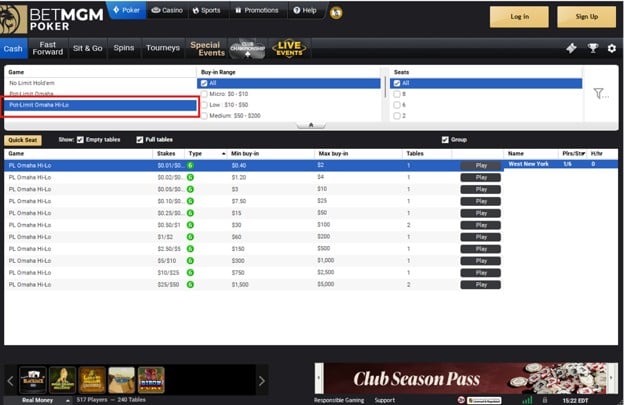
We offer both Omaha and Omaha Hi/Lo. In the Cash Games section, you can simply choose the table you would like to play at.
To locate Omaha and Omaha Hi/Lo tournaments, reference the tournament name:
- PLO in the tournament name stands for Pot Limit Omaha (This game variant is HIGH ONLY)
- PLO-8 stands for Omaha Hi/Lo
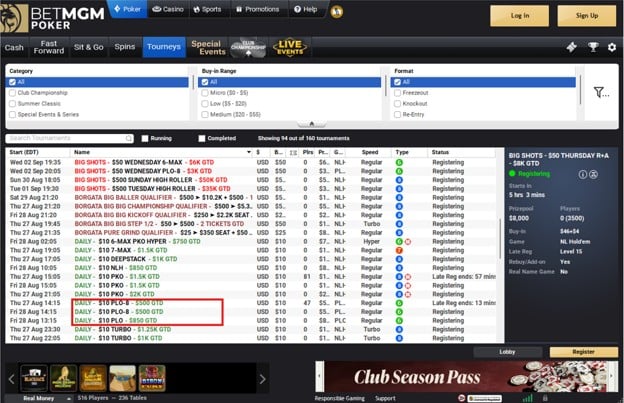
It is the players’ responsibility to join the appropriate variant. No compensation will be given in cases where a player joins the incorrect game.
You can also view the game variant when opening any table, by simply looking at the text on the felt, as shown below.
